Founder · Nicole Cain · Apr 20, 2026
The Structure Layer
I spent years running operations across modern businesses.
Client intake. Content production. Review cycles. Publishing. Reporting. Revenue tracking. Team coordination.
The systems that keep businesses alive.
And I watched them break in the same places, over and over.
Every week, the same pattern.
Smart people drowning in coordination.
Not because they lacked talent.
Because the structure wasn’t working.
The founder rebuilding context every Monday morning.
The creator producing endlessly without knowing what drives revenue.
The operator switching between Notion, Slack, Asana, and spreadsheets just to answer a simple question:
Are we on track?
Nobody was on track.
Everyone was managing chaos well enough to survive another week.
I was doing it too.
Fifteen hours a week on admin that didn’t move the business forward.
Becoming the bottleneck inside the very system I was responsible for.
That was the entry point into systems design.
The acceleration problem
Then AI arrived.
Instead of fixing the system, it accelerated the failure.
More output with the same infrastructure.
More content, tasks, stress.
Eight tools. None connected, contextual and better yet none accountable.
The promise was efficiency. The reality was fragmentation at scale.
We didn’t reduce work. We multiplied it.
Not because AI is flawed. Because we are generating intelligence into environments that were never designed to hold it.
We are pouring water faster into a bucket full of holes.
Behavior is environmental
Behavior is not random.
It is environmental.
Modern work no longer happens in physical offices or linear processes.
It happens inside digital environments that shape:
How we think
How we decide
How we coordinate
Software structures collaboration.
Interfaces guide attention.
Systems determine outcomes.
The internet is no longer a tool. It is an environment.

And most of these environments were never designed to support the speed, volume, and feedback loops introduced by AI.
The shift nobody is naming
When intelligence becomes abundant, it stops being the advantage.
Structure becomes the advantage.
Every major platform shift has followed this pattern.
Stripe did not invent payments.
It structured them.
Figma did not invent design.
It structured collaboration.
Shopify did not invent commerce.
It structured how it operates.
In every case, the structure layer became more valuable than the capability itself.
Now look at AI.
Everyone is building intelligence.
Better models. Better outputs. Faster responses.
Almost no one is building structure for it.
No one is asking:
Where does the output go?
How is it evaluated?
How does it improve?
How does the system learn?
That gap is where productivity disappears.
Quietly. Constantly. At scale.
Systems respond to structure
Nothing exists in isolation.
In biology, outcomes are not driven by single variables.
They emerge from interaction.
Gene expression depends on environment.
Hormones respond to inputs.
Adaptation is systemic.
Organizations behave the same way.
Performance is not talent.
It is structure.
Communication patterns > Workflow design > Information flow
These determine output.
Across domains, the same rule holds:
Systems respond to structure.
When structure is coherent, systems adapt.
When structure is fragmented, friction emerges.
Friction is not failure
Friction is not a people problem.
It is an architectural signal.
Burnout is not inefficiency.
It is misalignment.
Delayed decisions are not incompetence.
They are structural gaps.
Most organizations try to solve this linearly:
More tools
More meetings
More management
But complexity added to a broken system does not resolve it.
It amplifies it. The solution is not additive.
It is architectural.
The triadic system
Across biological, ecological, and cybernetic systems, stability rarely emerges from two variables.
It requires three.
Signal
Structure
Feedback
The GRID framework applies this to organizations:
Identity — what the system is optimizing for
Systems — how work is structured
Intelligence — how the system learns
Stability emerges when these evolve together.
Not in isolation.Not sequentially.
But as a coordinated system.
Design is not surface
Design is often mistaken for aesthetics.
Visual identity. Branding. Interface.
But design operates at a deeper level.
Design structures environments.
And environments shape behavior.
The systems we build determine:
How information flows
How decisions are made
How teams coordinate
How organizations learn
Design is not decoration.
It is environmental engineering.
Building the structure layer
I didn’t set out to build a company.
I set out to fix my own operations.
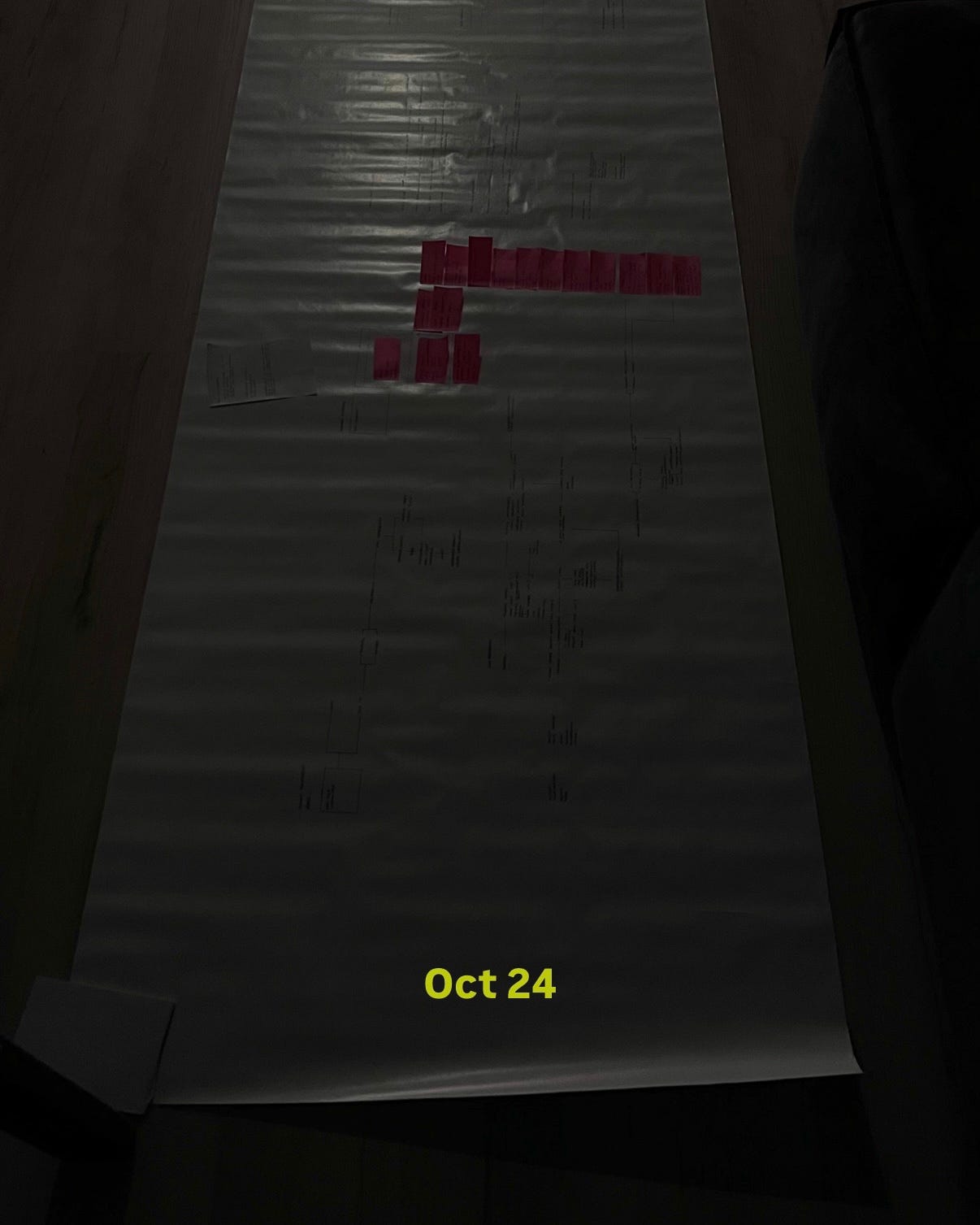
I mapped everything.
Client intake. Content. Review cycles. Publishing. Reporting.
Every step. Every break point.
Then I taught myself the skills I needed and I built the system I wished existed.
One environment.
One structure.
One loop.
Eighteen months later, it became GRID.
The adaptive workspace for modern teams.
Not a tool. A structure layer.
The layer that sits beneath your tools and above your work.
Where workflows are defined.
Where intelligence operates in context.
Where output compounds.
What structure makes possible
When structure is correct, output changes.
A single input can trigger an entire system.
A brief becomes research, writing, review, and publishing.
Automatically. Iteratively. Improving each time.
An operator connects their systems and sees:
Where revenue is concentrated
Where workflows break
Where time is lost
Not because they searched for it.
Because the structure revealed it.
This is not automation.
It is coordination.
Why this matters now
We are approaching a point where intelligence is no longer scarce.
Within a short horizon, everyone will have access to the same capability.
At that point, the differentiator is no longer:
Who has the best AI.
It is:
Who has the best system for using it.
The companies that win will not produce more.
They will coordinate better.
They will learn faster.
They will operate with clarity while others operate in noise.
The architect’s role
Technology now shapes the environments where human behavior occurs.
Designers are no longer creating tools.
They are constructing environments.
And those environments determine:
What is possible
What is visible
What is optimized
GRID emerged from a simple question:
What if organizations were designed as adaptive systems from the beginning?
An invitation
I’ve been building this in isolation.
Testing it inside real workflows.
Stress-testing it against real work.
Now I’m opening it up.
Not broadly.
But intentionally.
I’m looking for a small number of operators who feel this problem deeply.
People who are tired of managing tools.
Who know their business could run differently.
Who are ready to design structure, not just operate inside it.
If that’s you and you have made it this far, I want to build with you.
Closing
Adaptive systems do not survive because they are strong.
They survive because they are structured to learn. The question is not whether systems will evolve.
They always do.
The question is whether the environments shaping that evolution are designed intentionally.
Or left to emerge by accident.
—
Nicole Cain
Systems Designer | GRID Founder